
How Rubik's Cubes Can Help Creative Professionals Solve Their Work-Life Balance

Our lives are complex.
It’s easy to lose our balance trying to make sense of it all.
We inflate our issues by overthinking them.
Our problems seem bigger.
Our stress gets louder.
“Get this project done!”
“Improve your fitness!”
“Spend time with family!”
”Make more money and save!”
“Manage your schedule better!”
”Think of your long-term future!”
And so, we just do our best to push through, balancing it all as best we can.
But the trick to solving complex problems isn’t brute force—it’s simplification.
Break the complex into smaller, more manageable problems.
Then attack the pieces, not the whole.
Recently, I started searching for a way to make this idea more relatable and useful. It turns out there’s a legendary toy that can help reinforce this skill and bring more balance into your creative life.
It’s the Rubik’s Cube.
Rubik’s 101
The Rubik's Cube (not “Rubix” as I somehow had been telling myself for 30 years) was invented in 1974 by Hungarian architecture professor Erno Rubik to teach his students spatial awareness.
I bet you’ve seen hundreds of Rubik’s cubes in your life.
Maybe you’ve even tried to solve one yourself.
It’s the playful puzzle cube with 6 colors—white, yellow, red, blue, green, orange. Each side has 9 squares. The object of the puzzle is to take whatever complex starting position it’s in and transform it back into solid colors on all 6 sides.
Easy, right?
Not exactly.
Some might even say, “impossible.”
The reason it’s so difficult? The number of possible configurations for the Rubik's cube is over 43 quintillion (that's 43 followed by 18 zeros). 😅
Learning the Impossible
Writer / Director David Wain (Wet Hot American Summer) recently discussed his own fascination with Rubik’s Cubes in an interview with Michael Rosenbaum:
“Learning the Rubik’s Cube for me was a wonderful expression of how you can learn something that seems impossible… and day by day.. time by time, you get a tiny bit better at it. And that thing that seemed like a magic trick, or impossible at first—” oh, now I can do it!’”
David goes on to elaborate how sequential steps have been developed over time to solve nearly any of these configurations. Follow the steps, and like magic, anyone can solve the Rubik’s cube in ten minutes or less.
Even without these cheat codes, Rubik’s Cubes aren’t some impossible feat of intelligence or mind over matter. It’s just one “big” problem composed of several smaller ones.
In fact, the process of solving a Rubik’s Cube is the same as solving any of our complex life problems.
Solve a small problem.
Then another.
And another.
Keep going until all of the small problems are gone.
Repeat the process.
How Does this Apply?
At this point you might be asking yourself, “Ok, cool, Mike. Rubik’s Cubes are fascinating. But what does that have to do with my problem right now?”
There are two lessons:
Big problems get solved by breaking them into pieces and attacking them individually
Rubik’s Cubes are useful tools to improve your tactile skills as a creative pro
7 Skills You Can Unlock by Solving Rubik’s Cubes
Problem-solving - The cube is first and foremost a puzzle. By repeatedly trying to solve it, you’ll foster and grow your ability to solve visual problems. This is a great advantage for any creative or designer.
Persistence - When you first try to solve a Rubik’s Cube, it likely won’t be an instant success. Going through the effort over and over again will help you build mental resilience. A problem may seem daunting at first, but consistent efforts will make it easier each time.
Hand/Eye Coordination - By transforming the cube over and over again, you’ll begin to see patterns. You’ll begin to imagine the steps that need to be taken. You’ll anticipate them. Your mind will work behind the scenes and help your dexterity improve.
Complex to Simple - Solving cubes is inherently about transforming the complex problem in front of you into simpler steps. You don’t need to know all of the steps when you start. You just need to understand the best first step and then the next. You get better at it the more you practice.
Confidence Boost - At first, the cube will feel like the Mt. Everest of puzzles. But once you get some traction and solve it a few times, you’ll gain immediate confidence. You’ll realize that you are more than capable of solving the puzzle. And if so, why wouldn’t you be more than capable to solve other problems in your life?
Promote Growth Mindset - When we overthink problems, we limit ourselves. As Carol Dweck would say, we create a “fixed” mindset. This is when we believe that there are limits to what can be improved in our lives. But when we practice solving the cube, the opposite happens—we begin to believe that anything is possible. We create a “growth” mindset for ourselves. This limitless belief can do wondrous things to improve the quality of our lives.
Improve Focus - Solving the cubes can ultimately improve one of the most important skills we need against the problems of our lives—focus. When we improve our focus, we simply get more done. It’s not about being busy. It’s about being effective. When we’re effective and resilient, we have the freedom to navigate our lives better. Balance between work, life, and all the pieces in between, becomes far easier to manage.
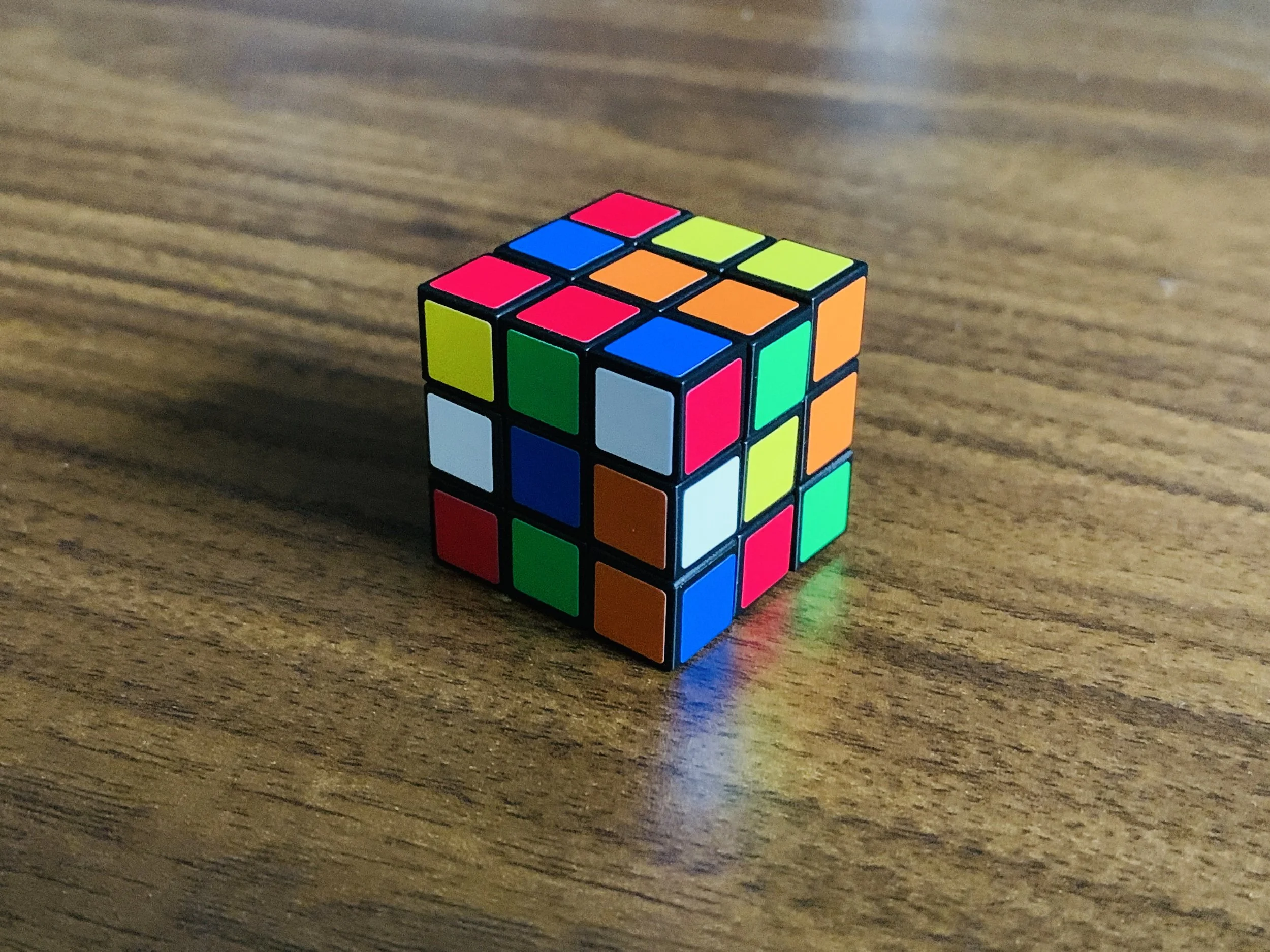
My Mini Rubik’s Cube (1in x 1in x 1in) - Great for puzzle solving on the go.
Final Thoughts
Our lives are complex, and so are the problems we face to keep it in balance.
It turns out that a Rubik’s Cube, no matter how difficult it may seem from the outset, can be solved in 20 steps or less. It’s a theorem known as God's Number. (It took a bank of computers at Google 35 CPU-years to calculate.)
Just remember that any problem you face is just a series a simple steps away from being solved.
They may not be easy steps, but keeping them simple can make all the difference between a life in chaos and one in balance.
Rubik’s Cube is a fun way to strive for the latter.
TL; DR
Our lives are complex
We overthink our problems
Our problems can feel impossible to manage
Break complex problems into smaller ones
Rubik’s Cube is an analogy for the process
Rubik’s Cube can train us to simplify
Quote of the Week
Motivation for the days ahead of you.
“Life isn’t about finding pieces of a puzzle. It’s about creating and putting those exceptional pieces together.”
— Glenn van Dekken
That's all for now.
Stay creative, my friends—and have a great week!