
How the Eisenhower Matrix Can Help Radically Improve Your Creative Life Balance

Creatives don’t have a TIME management problem.
They have a TASK management problem.
Do you often find yourself overwhelmed by the demands of your work and struggling to prioritize your creativity effectively?
I’ve been practicing within the profession of Architecture for over 15 years. More than half that has been as a licensed Architect and Project Manager.
As I’ve climbed the ranks and built up my design career, I’ve noticed two things:
My time is spent increasingly on management-centric, non-creative tasks
My focus is under constant bombardment by distractions (some good, some bad)
At this stage of my career, I find my creative time more valuable than ever.
I’ve also found that many people (especially creatives) aren’t particularly great at managing their tasks. This disconnect in managing tasks leads to busy work for the sake of being busy.
They get stuck in the things that are neither urgent nor important:
At work:
Striving for Inbox Zero at all costs
Saying “Yes” to errands that derail their flow
Responding to every Teams/Slack message within seconds
At home:
Doom-scrolling Social Media
Watching excessive amounts of TV
Falling down the YouTube rabbit hole
But then, when do we get to “create” if we’re always so busy?
The answer:
Make better choices.
In all my years as an Architect and Project Manager, one of the greatest tools for task management is also one of the simplest.
It’s called “The Eisenhower Matrix.”
In this comprehensive guide, we will explore how the Eisenhower Matrix (”EM” for short) can be a game-changer for creative professionals like architects, designers, writers, and more.
Let’s take a closer look at:
What the Eisenhower Matrix is.
How Creatives should use EM as a tool
The benefits of using EM in their lives
Eisenhower Matrix 101
What is the Eisenhower Matrix?
The Eisenhower Matrix, also known as the Urgent-Important Matrix, provides a framework for categorizing tasks based on their urgency and importance.
It was developed by Stephen Covey (Author of “The 7 Habits of Highly Effective People”) from the practices of Dwight D. Eisenhower, 34th President of the United States.
Eisenhower was a highly accomplished individual who understood the value of effective time management. He famously said, "What is important is seldom urgent and what is urgent is seldom important."
By applying the principles of the Eisenhower Matrix, you can gain clarity on your priorities, make informed decisions about where to allocate your time and energy, and ultimately unlock your creative potential.
The Design of the Eisenhower Matrix
In a practical sense, the Eisenhower Matrix is simply a rectangle divided into four quadrants. These quadrants help you categorize tasks and assign them a next step of action.
Below is a sketch of the EM, a basic list of its quadrants, and related actions.
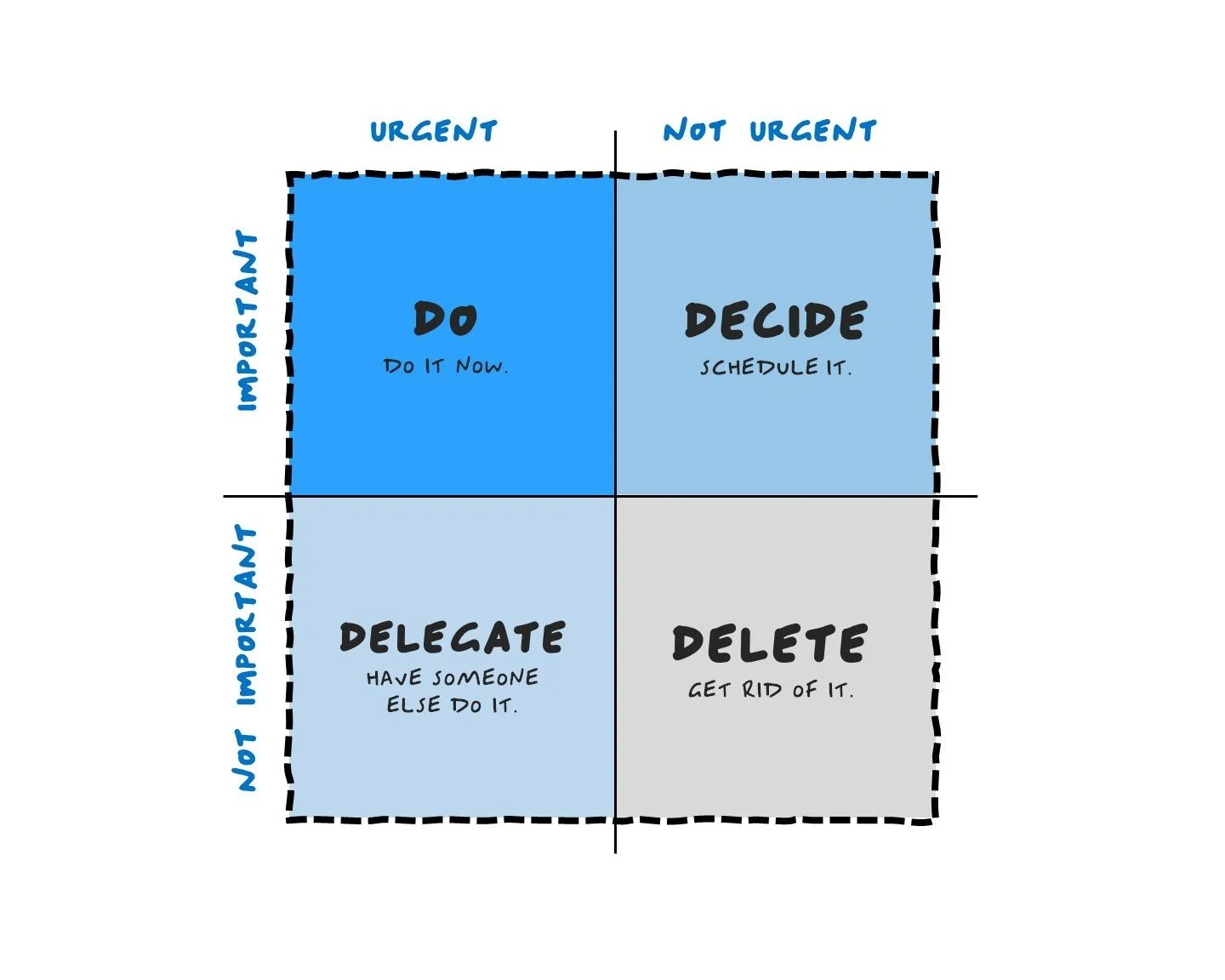
Image: The Eisenhower Matrix
1. Urgent and Important (Do)
Tasks that require immediate attention should be done first.
2. Important, but Not Urgent (Decide)
Tasks that are significant but can be planned and done later.
3. Urgent, but Not Important (Delegate)
Tasks that are time-sensitive but have low significance. These tasks can be delegated or postponed.
4. Not Urgent and Not Important (Delete)
Asks that have low significance and can be eliminated or postponed indefinitely.
The Difference Between the Urgent and the Important
Before diving into the details of the Eisenhower Matrix, it's important to grasp the distinction between the urgent and the important.
In the context of this matrix, urgent tasks are those that require immediate attention and have impending deadlines. They often demand quick action and may come with clear consequences if not addressed promptly.
On the other hand, important tasks contribute to your long-term goals and align with your values. They may not have immediate deadlines, but neglecting them can hinder your progress and hinder your potential for growth as a creative professional.
By being able to differentiate between the urgent and the important, you can make more informed decisions about how to allocate your time and energy.
Looking closer at the EM, I’ve observed that most creatives spend their time in the wrong quadrant, focusing on the busy work. These are the things that make you feel like you’re getting things done, when they’re more often than not, just distractions.
This is a dangerous, time-sucking path for creatives.
Another version of the matrix below shows what this looks like:
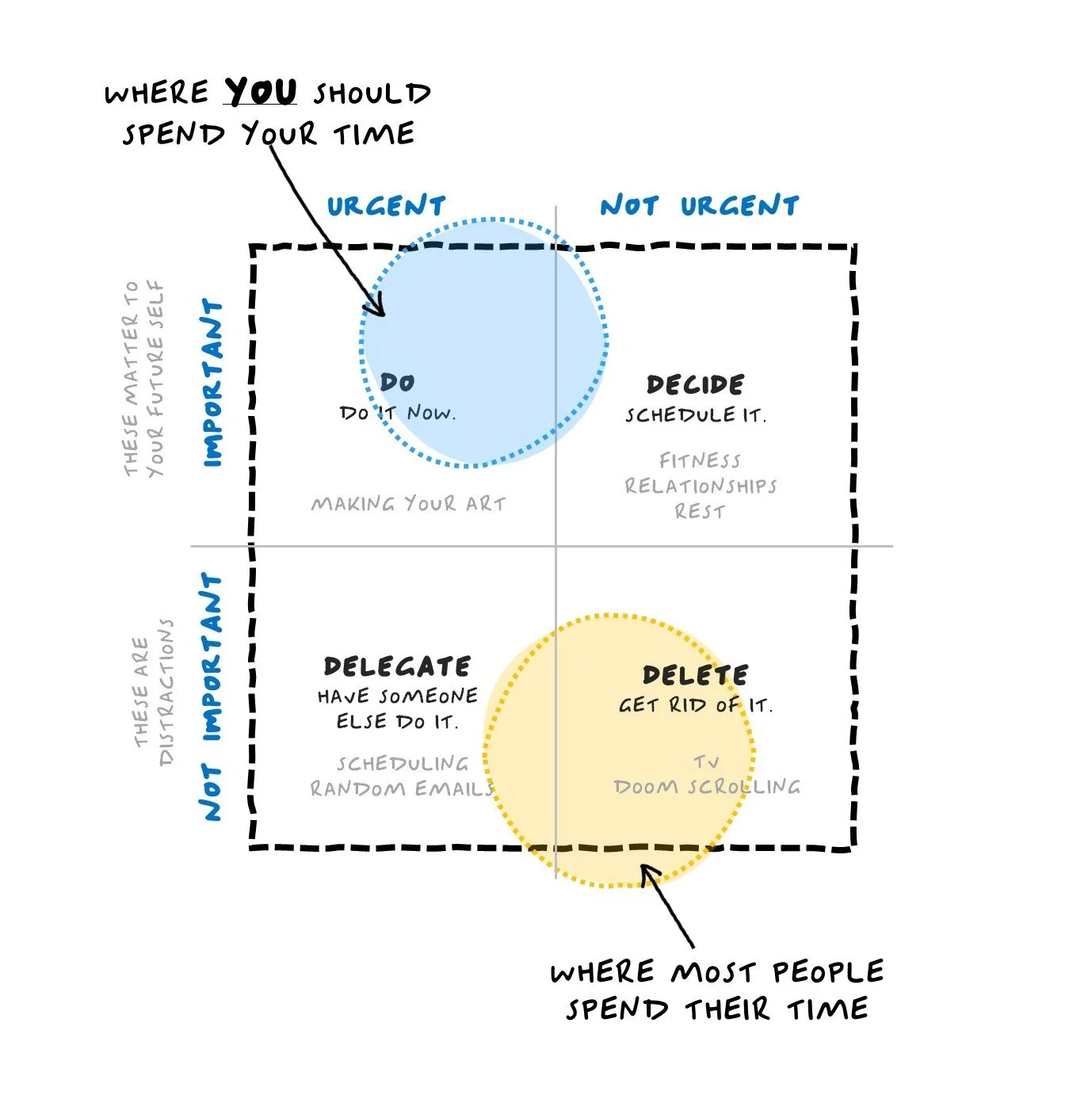
Image: The Eisenhower Matrix (Time Spending)
A Detailed Breakdown of the Four Quadrants of the Eisenhower Matrix
The Eisenhower Matrix divides tasks into four quadrants based on their urgency and importance. Let's explore each quadrant and its implications for creative professionals.
—
Quadrant 1: Do (First) - Urgent and Important
In the first quadrant, you will find tasks that are both urgent and important.
These tasks require your immediate attention and have a direct impact on your creative output and professional growth. They are often time-sensitive and come with clear consequences if not completed in a timely manner.
Examples:
meeting project deadlines
responding to urgent client requests
resolving technical issues that affect your work.
It is crucial to prioritize these tasks and address them promptly to ensure your creative projects stay on track and your clients remain satisfied. By focusing on the tasks in this quadrant, you can prevent potential crises and maintain a sense of control over your work.
—
Quadrant 2: Decide (or Schedule) - Not Urgent but Important
The second quadrant of the Eisenhower Matrix is dedicated to tasks that are important but not necessarily urgent.
These tasks contribute to your long-term goals, personal growth, and creative development. Although they may not have immediate deadlines, they are crucial for your success as a creative professional.
Examples:
attending professional development courses
conducting research for future projects
engaging in activities that enhance your creative skills.
This category also tends to be where long-term creative projects live. It’s important for creatives to find time to design, write, and focus on their craft. It’s not urgent in the short term, but without focused blocks to work on the craft, creatives will fall behind on their projects and their development.
It is essential to schedule dedicated time for these tasks to ensure they receive the attention they deserve. By consistently investing in activities in this quadrant, you can improve your creativity, expand your knowledge base, and stay ahead in your field.
—
Quadrant 3: Delegate - Urgent but Not Important
The third quadrant of the Eisenhower Matrix encompasses tasks that are urgent but not necessarily important for you to handle personally.
These tasks require immediate attention but do not contribute significantly to your long-term goals or creative endeavors. As a creative professional, your time and energy are valuable resources, and it is crucial to delegate tasks in this quadrant whenever possible.
Examples:
administrative duties
responding to non-critical emails
attending meetings that are not directly related to your creative projects
By delegating these tasks to capable individuals, such as assistants or team members, you can free up time for more important and meaningful work. Effective delegation allows you to focus on tasks that align with your unique skills and expertise, ultimately enhancing your creative output.
—
Quadrant 4: Delete - Not Urgent and Not Important
The fourth and final quadrant of the Eisenhower Matrix is dedicated to tasks that are neither urgent nor important.
These tasks are often time-wasters that provide little to no value in terms of your creative output or professional growth.
Examples:
excessive time spent on social media
mindless browsing
engaging in activities that do not contribute to your creative or personal development
It’s essential to identify and eliminate such tasks to reclaim valuable time and focus on activities that truly matter. By consciously avoiding time sucks in this quadrant, you can create more space for creativity, self-care, and work-life balance.
WARNING: If you see a task that falls into this category, do everything in your power to jettison it completely from your world. It does not belong and you should not be spending any more of your precious time on it.
Implementing the Eisenhower Matrix as a Creative Professional (in 6 Easy Steps)
Now that you have a solid understanding of the Eisenhower Matrix and its implications for creative professionals, it's time to put this powerful tool into action. Here are some practical steps to implement the Eisenhower Matrix and optimize your life as a creative professional:
Step 1: Identify and List Your Tasks
Begin by making a comprehensive list of all the tasks and responsibilities you currently have. This can include both professional and personal commitments. Be thorough and ensure that you capture all the activities that demand your time and attention.
—
Step 2: Categorize Tasks into Quadrants
Next, categorize each task from your list into one of the four quadrants of the Eisenhower Matrix. Determine whether each task is urgent or not and whether it is important or not. This process will provide you with a visual representation of how you currently allocate your time and energy.
—
Step 3: Do
Start by focusing on the tasks in Quadrant 1 - the tasks that are both urgent and important. These tasks require your immediate attention and should be addressed promptly to prevent any negative consequences.
Create a plan to tackle these tasks efficiently and effectively, ensuring that you meet deadlines and deliver high-quality work.
—
Step 4: Decide (or Schedule)
After addressing the urgent and important tasks, shift your focus to Quadrant 2 - the tasks that are important but not necessarily urgent. These tasks contribute to your long-term goals and creative growth.
Schedule dedicated time in your calendar to work on these tasks, ensuring that they receive the attention they deserve. By consistently investing in activities in this quadrant, you can enhance your creativity, expand your skill set, and stay ahead in your field.
—
Step 5: Delegate
Review the tasks in Quadrant 3 - the tasks that are urgent but not necessarily important for you to handle personally. Identify tasks that can be delegated to capable individuals, such as assistants, team members, or freelancers.
Effective delegation allows you to free up valuable time and focus on tasks that align with your unique skills and expertise.
—
Step 6: Delete
Finally, eliminate tasks in Quadrant 4 - the tasks that are neither urgent nor important.
These tasks are often time-wasters that provide little value in terms of your creative output or professional growth. Be mindful of activities that fall into this quadrant and consciously avoid them.
Instead, redirect your time and energy towards meaningful tasks and activities that contribute to your creative development and work-life balance.
4 Benefits of Using the Eisenhower Matrix for Creative Professionals
By implementing the Eisenhower Matrix in your life as a creative professional, you can unlock numerous benefits that will enhance your productivity, creativity, and overall satisfaction. Here are some of the key advantages:
1. Improved Time Management
The Eisenhower Matrix provides a clear framework for prioritizing tasks based on their urgency and importance. By categorizing your tasks and focusing on the most critical ones, you can effectively manage your time and ensure that your creative projects receive the attention they deserve. This tool helps you avoid the trap of spending time on non-essential tasks that do not contribute to your long-term goals.
—
2. Enhanced Creativity and Focus
By eliminating time-sucks and non-essential tasks, the Eisenhower Matrix allows you to create more space for creativity and deep work. By consciously allocating time for important but not urgent tasks, you can nurture your creative potential, explore new ideas, and engage in activities that enhance your skills and expertise. This focused approach to your work will lead to increased productivity and improved creative output.
—
3. Work-Life Balance
As a creative professional, maintaining a healthy work-life balance is crucial for your overall well-being and long-term success. The Eisenhower Matrix helps you prioritize tasks and make informed decisions about where to allocate your time and energy. By effectively managing your workload and eliminating non-essential tasks, you can create more time for personal pursuits, self-care, and quality time with loved ones.
—
4. Reduced Stress and Overwhelm
Feeling overwhelmed by the demands of your work is a common challenge for creative professionals. The Eisenhower Matrix empowers you to take control of your tasks and prioritize them effectively. By addressing urgent and important tasks promptly, scheduling important but not urgent tasks, and delegating tasks that are urgent but not important, you can reduce stress, prevent burnout, and maintain a sense of control over your work.
Final Thoughts
As a creative professional, your time and energy are precious resources.
The Eisenhower Matrix provides a powerful framework for managing your tasks, prioritizing effectively, and unlocking your creative potential. By understanding the distinction between the urgent and the important, you can make informed decisions about where to allocate your time, energy, and focus.
Remember, without the Eisenhower Matrix, you may be spending your time poorly, hindering your ability to pursue more creative endeavors and achieve the work-life balance you desire.
As Author Gary Keller once asked, "What's the ONE Thing I can do, such that by doing it, everything else will be easier or unnecessary?”
➡️ Spend more time with the thing that lights you up in your soul.
➡️ Spend more time nurturing the pieces of your life that give you the energy to do more of that one thing.
The Eisenhower Matrix can help you do both.
TL; DR
Creatives have a TASK Management Problem
Eisenhower Matrix 101
What is the Eisenhower Matrix?
The Design of the Eisenhower Matrix
The Difference Between the Urgent and the Important
A Detailed Breakdown of the Four Quadrants of the Eisenhower Matrix
Implementing the Eisenhower Matrix as a Creative Professional (in 6 Easy Steps)
4 Benefits of Using the Eisenhower Matrix for Creative Professionals
Quote of the Week
Motivation for the days ahead of you.
“Either you run the day, or the day runs you.”
— Jim Rohn
That's all for now.
Stay creative, my friends—and have a great week!