
How to Supercharge Your Personal Goals with a Creative Theme (2024)

At a Glance
Goals are great, but they don’t work for everyone.
Themes can help filter decisions you make all year long to keep you on track.
Let’s discuss how to make a theme tailored to exactly who you want to become.
I found myself in an unfamiliar place and time as the new year turned over.
Los Angeles. 3 hours behind my normal time zone. Like living in the past while the rest of my world lived in real-time.
I was sitting in a Starbucks two blocks from the hotel, ready to take on all the city had to offer. But first, I wanted to reflect on my year.
I’ve made goals before. But this year felt different. To be fair, they always do.
Maybe it was the excitement of being somewhere new.
Maybe it was the crisp venti iced coffee with a splash of 2% milk and vanilla syrup instead of classic. (A tried and true way to inspire me to write)
As I listed out the good from the past 365 days, and the good I wanted from the year to come, I knew this year would be something special.
I could feel it.
So instead of a list of goals alone, I made a theme to capture that feeling of promise. A way to remind myself of who I wanted to be and what I wanted to experience all year long.
Why?
Every year we set aspirational goals to do better.
But you and I know—they don’t always stick.
If you’ve lost sight of your goal, you’re not alone.
It’s not uncommon to abandon a goal (especially a complex one) within the first month.
We push too hard
We let a habit slip
We let go
But goals aren’t the only way to improve your life.
If a goal is too specific or daunting, try a theme instead.
The Power of a Theme
Like a mantra you repeat to yourself when you’re feeling low, a theme can give your very next action purpose and direction. Our brains relate to the tone of words and phrases.
For example:
If you hear the word “hero,” you may imagine Superman, a firefighter, or someone who inspires you (like a parent or loved one).
If you hear the word “villain,” you may imagine Voldemort, a murderer, or someone who antagonizes you (like a boss or competitor).
The same goes for themes.
Themes are powerful filters for our actions.
When you say a theme to yourself that means something personal to you. It resonates with who you’re trying to become. Your next choice is more likely to align with that feeling.
Things to remember about Themes:
Themes are simple and emotionally resonant
Themes can (and should) guide basic goals
Themes are easy to remember
The 4 Easy Steps to Develop a Theme
Defining a new theme for myself each year only takes a few simple steps. Steal these and apply them to your own life.
Step 1 - Analyze the themes and patterns of previous years.
Step 2 - Assess what is going on in my life right now and what areas of my life I would like to grow in the next year.
Step 3 - Write a list of words that may trigger a feeling of what I’m trying to achieve in the next year.
Step 4 - Pick a theme that resonates strongly with me and go for it.
Let’s walk through the steps one by one. I’ll show you how I developed my own theme for 2024.
Step 1 — Analyze the themes and patterns
The benefit of tracking my past themes is that I can use them to see patterns in who I was and where I’m going. If you don’t have a trail of themes, don’t worry. We’ll get to that!
Here are my themes from 2016 to 2023:
2016 = Expansion
2017 = Metamorphosis
2018 = Experimentation
2019 = Consistency
2020 = Expression
2021 = Simplify
2022 = Sculpt
2023 = Discipline
2024 = ???
For myself, I recognize that I tend to go through a bit of flux between diverse activity and focused activity. One year is about consistency, and the next is about expression. Two ideas that on the surface may not conflict, but their execution and the intent behind them do.
This is important because it allows me see how one theme can shape the next.
During a year of consistency, I wrote a newsletter every week for the entire year. That’s only because, in the year of experimentation, I tried a variety of different styles and formats to figure out what types of content creation interested me.
Step 2 — Assess my life and how I want to grow in the next year
This step is likely the most specific to you, your situation, and where you see yourself in the future. First, we have to work with the data.
Think back to last year and ask yourself 4 questions.
What went well and what went wrong?
How did you feel about last year?
What is something you have under control?
What is something you’d fundamentally like to work on this year?
This is how I answered them.
Q1 — What went well and what went wrong?
What went well:
I took 3 major courses to improve my skills—one on writing, one on LinkedIn content creation, and one on Architecture Firm Business Practices.
I consistently showed up on LinkedIn trying different content posting styles and meeting new people.
My physical fitness was crazy consistent across running, biking, and strength training.
I submitted the final drawings on the largest design project of my life to date.
I traveled to a new city—significantly farther West than I ever have.
I completed my first half marathon.
I spoke at a Mental Health Summit.
I ran my fastest 5k ever.
What went wrong (aka “less well”):
I was inconsistent with my reading habit.
I made almost no progress on my book.
I had issues getting my sleep in check.
I had a running injury in March.
Q3 — How did you feel about last year?
Overall, I felt great about last year. I tried to “live in the moment” whenever possible and did some memorable firsts.
Q3 — What is something you have under control?
My fitness habit is solid in terms of regular exercise. I don’t always want to go the gym, but I do anyway. I always feel better after because taking action, no matter how small, keeps moving me forward.
Q4 — What is something you’d fundamentally like to work on this year?
My book. My sleep habit. My social life. My travel plans.
After I answered these questions, I could instantly tell how much I appreciated getting outside of my comfort zone, meeting new people, and finding new places.
Step 3 — Write a list of words that may trigger a feeling
After assessing my previous year, I write down a bunch of words to represent next year. I keep going until I find something that resonates with me deeply.
This year, my list looked something like this:
New
Unknown
Breakout
Rocket
Rise
Grow
Fun
Soar
Climb
Sail
Ascend
Escalate
Adventure
Step 4 — Pick a theme and go for it.
While many of the words I wrote down could have worked as my 2024 theme, none of them resonated with me the way “Adventure” did.
How did I know?
I could feel myself light up when I heard it. The best themes fill you with such positive energy that it’s difficult to imagine your theme as anything else.
That said—if this is your first time picking a theme, just pick one you know you can commit to for the next year and go for it.
Side Note: If a year still feels too intense, make it 6 months or even 3. Commit to enough time that you can evaluate the results. A week or a month may not be enough.
A theme will give you focus, but also give you some much-needed wiggle room for any goals you attach to it. Every year I prioritize my theme first and my goal second.
Let me say that again.
Every year, I prioritize my theme first and my goal second.
I’ve been at this long enough to recognize that life has a funny way of messing with specific goals. I find that I’m a much happier person when I pursue goals from the broader sense of how I want to sculpt my life in the long term.
Yes. I still have goals.
But my goals aren’t purely binary anymore. They’re infused with a theme that guides me and motivates me throughout the year. If I need to adjust, I don’t beat myself up about it.
I move forward.
Always forward.
Final Thoughts
Last year, I improved my “discipline” when it came to my writing online and my fitness outside.
This year, my theme is "Adventure."
I’m going to put myself out there this year in uncomfortable, but exciting ways. I’m going to see more of the world and explore what the world has to offer more.
You can take the same steps I did to develop a theme for yourself and track the results over time. Try things out, assess how they went, understand the lessons they reveal, and use those experiences to shape new ones.
It can be anything. But it should be something that resonates with YOU.
So, the million-dollar question:
“What is your "theme" for 2024?”
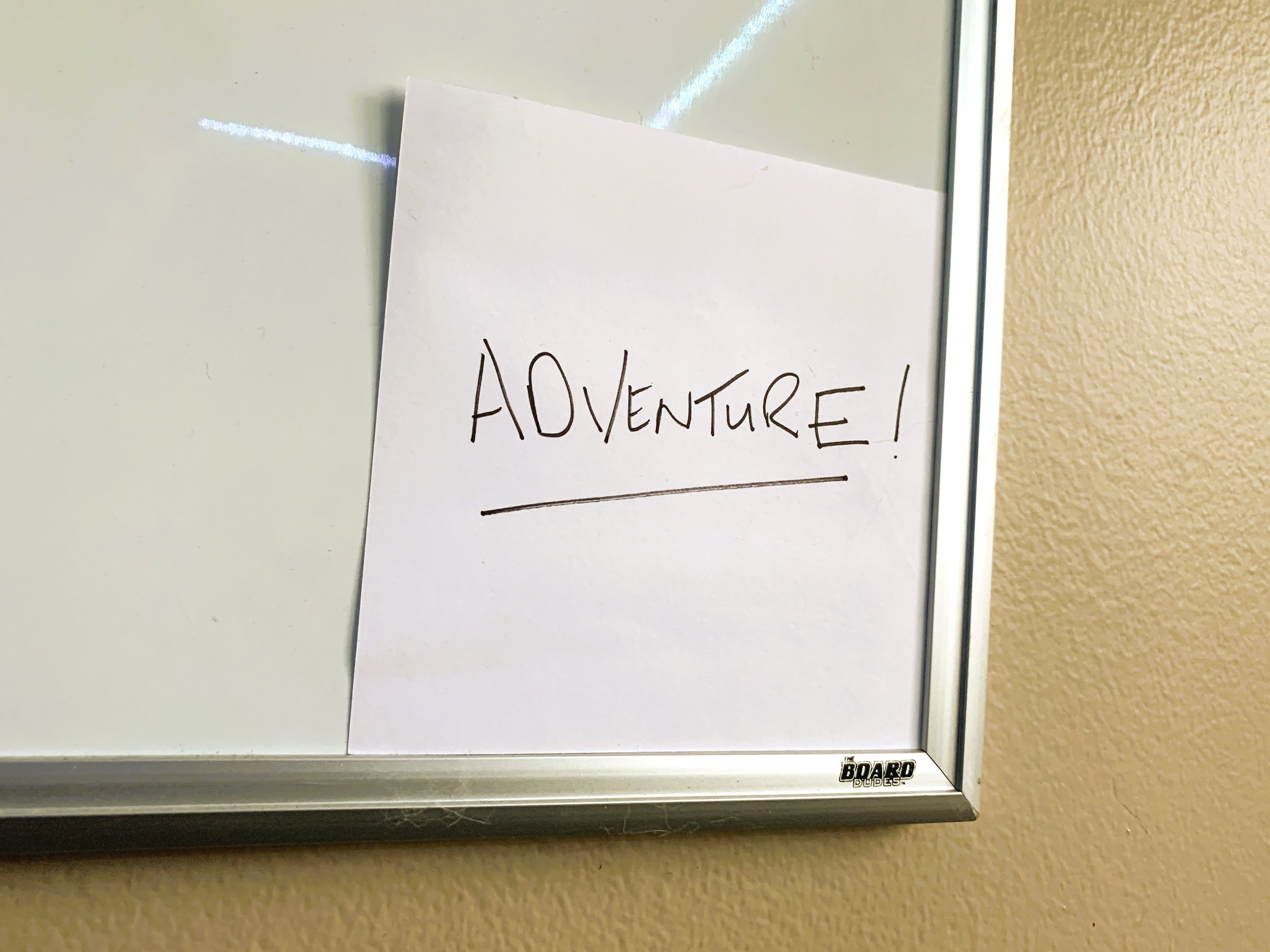
This reminder sits directly above my home office computer screen.
Bonus Tip: Once you find a Theme for your year, put it front and center where you'll see it often.
TL; DR
Goals are great, but they don’t work for everyone
Themes can help filter decisions you make all year long
Analyze the themes and patterns of previous years
Assess your previous year and where you want to go
Write a list of words that trigger a feeling
Pick a theme that resonates strongly and go for it
That's all for now.
Stay creative, my friends—and have a great week!